20th July, 2026

Common Questions Answered

What is next after you have purchased a life insurance policy? Who would get the payout when you pass away? 

Insurance nomination is a critical aspect of managing your insurance policy, ensuring that the benefits reach your intended beneficiaries without complications. Let us take a look at some frequently asked questions in this article.

1. What is insurance nomination and why should I make a nomination for my policy?
Insurance nomination is essentially your way of ensuring that the benefits of your insurance policy are handed over to the people you care about. Think of it as a safety net for your loved ones.

It gives you absolute control on how proceeds are to be distributed. This prevents any conflicts between your loved ones that may arise over the distribution. It also allows them to receive payouts promptly, especially in times when they need it the most.
 

2. What happens when you pass on without making a nomination for your policy?
A death claim will be paid to the “Proper Claimant” as defined by the Insurance Act. The insurance company may pay up to SGD150,000 to the “Proper Claimant” according to the law but this person may not be the intended beneficiary.

Anything above SGD150,000 will be paid to the administrator(s) under Grant of Letters of Administration (if no Will has been made) or executor(s) under Grant of Probate (if a Will has been made). It may take some time for these legalities to be processed, hence delaying the payout.

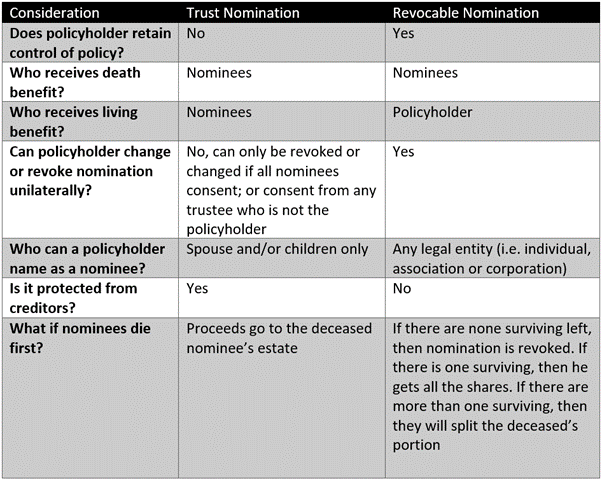
3. What is the difference between trust nomination and revocable nomination?
Lost in the jargon? Let us simplify it for you.

Once Trust Nomination is made, you are unable to change or revoke it without the consent of your nominees or trustee. It’s a commitment, and it ensures that your benefits are protected from any potential creditors. But the catch: because it’s irrevocable, you need to be absolutely certain about your decision.

Revocable Nomination is a bit more flexible.
You can change, add, or remove nominees as you see fit, without needing anyone’s consent. It gives you the flexibility should you need to make changes in light of life’s ever-changing circumstances. However, there’s a slight twist; it is not protected from creditors.

4. What is the Intestate Succession Act?
What happens if you do not have a will or nomination done? In the absence of a will, your estate will be distributed according to the Intestate Succession Act.

5. Can Muslims make nomination on their policies?
Yes. A FATWA was issued in 2012 mentioned that revocable insurance nomination is a new form of financial planning which is in accordance to Islamic principles. The Fatwa Committee is of the opinion that revocable insurance nomination is the same as CPF nomination, and both are accepted as valid forms of hibah.

6. Can I make a nomination for a policy bought on my spouse / children’s life?

You are not able to do so. The policy will be consolidated with your other assets and fall under the estate of the policy owner.

If there is a Will, and the Will contains instruction of the policy, executor will execute accordingly. If there is no Will, it will be distributed based on Intestate Succession Act.

7. Under what circumstances insurance nomination might not be adequate?

There are many situations where an insurance nomination is not the most suitable way to distribute your insurance proceeds. One of the more common situations is when you have vulnerable loved ones, either they might not be able to handle a large sum of money, or they are individuals with special needs.

If you have yet to make an insurance nomination, it is perhaps time for you to rethink and reach out to me if you wish to do so. Insurance nominations are free and we will be most happy to assist you and definitely welcome any questions that you may have.